
Available RPA Master Mixes
biotechrabbit offers RPA Master Mixes for DNA and RNA virus detection.
The Basic format supports endpoint detection such as LFA, while the Exo format enables real-time fluorescence readout.
Explore all RPA Master MixesThe ongoing outbreak of Bundibugyo virus disease has become the largest Ebola outbreak ever recorded in the Democratic Republic of the Congo. Behind every number are patients, families and health workers facing an exceptionally difficult public health emergency.
WHO data for the Democratic Republic of the Congo as of 26 August 2026. Outbreak figures change as surveillance and reporting continue.
The outbreak was confirmed in May 2026 in the Democratic Republic of the Congo and Uganda. It is caused by Bundibugyo ebolavirus, one of the orthoebolaviruses known to cause severe disease in humans. Transmission is continuing in the DRC, while Uganda and France completed their 42-day enhanced monitoring periods in August.
The response is complicated by insecurity, displacement, limited access to healthcare, highly mobile populations and pressure on laboratory and public health capacity. These conditions can delay the recognition of cases, interrupt contact follow-up and make it harder to reach affected communities.
Rapid recognition and testing can shorten the time between suspicion and appropriate isolation measures.
Timely testing can help patients reach appropriate care sooner, an important factor in reducing mortality.
A confirmed result allows response teams to start contact tracing and monitoring without avoidable delay.
Faster public health action can reduce opportunities for transmission in households, communities and healthcare facilities.
Ebola cannot be diagnosed from symptoms alone. WHO guidance emphasizes rapid laboratory diagnosis because early symptoms overlap with diseases such as malaria. Molecular methods, including reverse-transcription PCR, are used to detect viral RNA and support confirmation within an established testing algorithm.
Access to suitable laboratory infrastructure can be difficult in remote or resource-constrained settings. This creates a strong need for research into decentralized molecular workflows that are faster, robust and less dependent on complex thermal cycling equipment.
Recombinase Polymerase Amplification (RPA) amplifies nucleic-acid targets at a constant low temperature. Without repeated heating and cooling cycles, RPA can simplify instrumentation and shorten the amplification step. When combined with a Lateral Flow Assay (LFA), amplified targets can be visualized on a compact strip, supporting research into simple endpoint readouts.
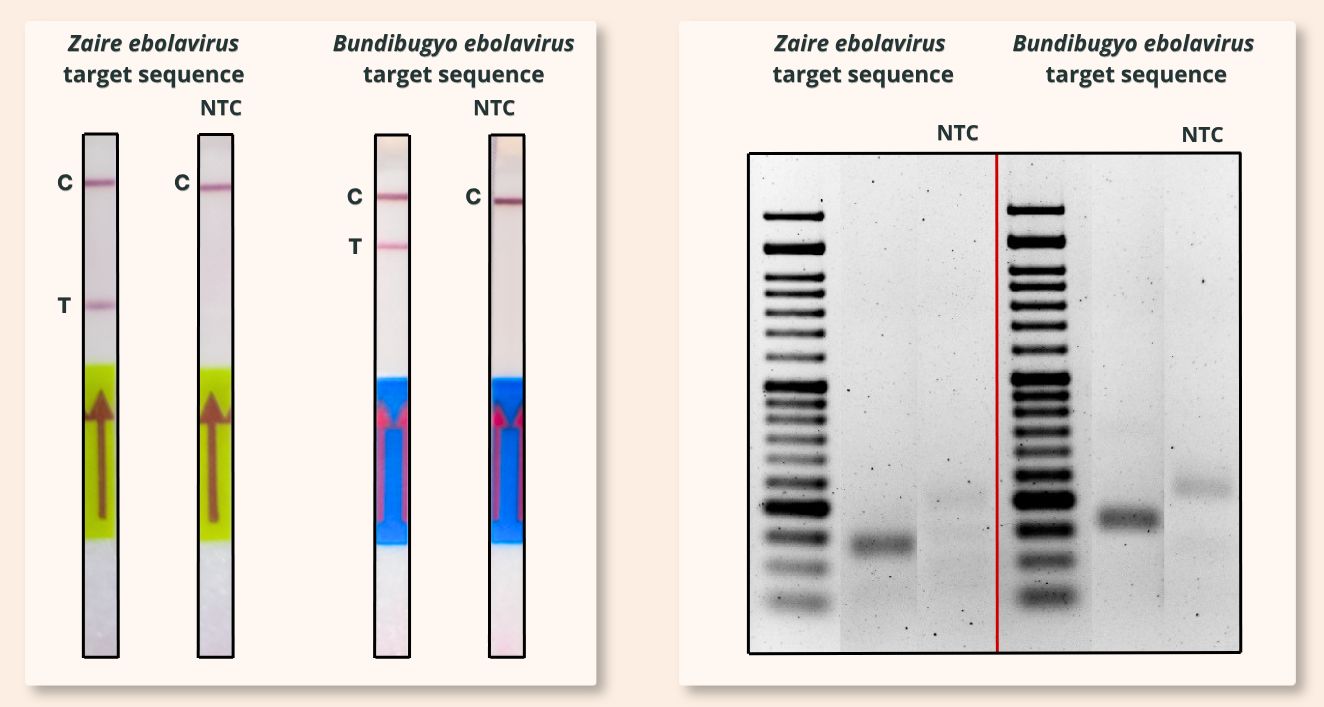
biotechrabbit offers RPA Master Mixes for DNA and RNA virus detection.
The Basic format supports endpoint detection such as LFA, while the Exo format enables real-time fluorescence readout.
Explore all RPA Master MixesExplore biotechrabbit RPA reagents for isothermal amplification, lateral flow and fluorescence-based assay development.