
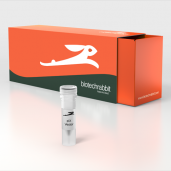
biotechrabbit™ 4X LYO-ready CAPITAL™ 1-Step qRT-PCR Probe Master Mix Plus is a ready-to-use, four-times-concentrated formulation containing an adjusted concentration of heat-labile Uracil-DNA Glycosylase (HL-UDG) to minimize the risk of carryover contamination. The mix includes all enzymes, dNTPs, excipients and stabilizers required for producing in-house lyophilizates, with the option to include primers and probes.
Time-efficient lyophilization is possible for both high and low volumes of the master mix without collapse of the lyophilizate. The resulting lyophilizate is highly resistant to humidity and dissolves rapidly in the provided reconstitution buffer. The master mix is optimized for real-time PCR quantification of RNA templates, including mRNA, total RNA and viral RNA from a wide range of targets. It ensures high specificity and sensitivity in single and multiplex amplification, making it an excellent choice for extremely low-copy-number targets in pathogen detection.
4X LYO-ready CAPITAL™ 1-Step qRT-PCR Probe Master Mix Plus uses a proprietary formulation for efficient reverse transcription and qPCR in a single tube.
|
Component |
Composition |
|
4X CAPITAL™ 1-Step qRT-PCR Probe Master Mix Plus |
4X concentrated formulation of a CAPITAL™ 1-Step qRT-PCR Probe Master Mix Plus |
|
4X qRT-PCR Probe Reconstitution Buffer |
Optimized qRT-PCR reconstitution buffer in 4X concentration |
|
Storage |
Store at −20 °C until expiry date. |
Prevention of contamination
RNase contamination is a concern when handling RNA. To minimize the risk of contamination and prevent RNA degradation, follow the guidelines below:
- Wear disposable gloves when handling the solutions.
- Dedicate separate sterile areas for the preparation of samples and reaction mixtures.
- Use molecular-grade nuclease-free water and reagents.
- Include a non-template control reaction in every PCR assay.
Recommendations before starting a lyophilization project
- The formulation is optimized for freeze-drying both single and multiple reactions with a reaction volume of 20 µl.
- Optional: Prepare concentrated primers and probes in molecular-biology-grade water and restrict their volume to a maximum of 20 % of the LYO-ready master mix.
Calculation examples
Three calculation examples for a 20 µl reaction size:
Parameter | Example A | Example B | Example C |
qRT-PCR volume | 20 µl | 20 µl | 20 µl |
Reactions per bead/cake | 1 | 5 | 25 |
Number of beads/cakes | 1 | 100 | 200 |
Total number of reactions | 1 | 500 | 5000 |
Total reaction volume | 20 µl | 10 ml | 100 ml |
Pipetting scheme
Divide the total reaction volume above by a factor of 4. Minimize the volume of primers and probes. Do not add water.
Component | Example A | Example B | Example C |
4X LYO-ready CAPITAL™ 1-Step qRT-PCR Probe Master Mix Plus | 5 µl | 2.5 ml | 25 ml |
Optional: Primers and probes | ≤1 µl | ≤500 µl | ≤5 ml |
Volume to freeze-dry per bead/cake | 5–6 µl | 25–30 µl | 125–150 µl |
Suggested lyophilization protocol
Step | Time* | Temperature | Pressure |
Freezing | 120 min | −40 °C | — |
Primary drying | 600 min | −40 °C | 0.12 mbar / 12 Pa |
Secondary drying | 300 min | 25 °C | 0.01 mbar / 1 Pa |
*The duration of freeze-drying cycles depends on the lyophilizate volume, the equipment, and the type and dimensions of the vials.
Reconstitution of lyophilized master mix
- Add the required volume of reconstitution buffer to the lyophilized CAPITAL™ 1-Step qRT-PCR Probe Master Mix Plus, as shown in the examples below.
- Mix well. The lyophilizate should dissolve rapidly.
- Store the reconstituted CAPITAL™ 1-Step qRT-PCR Probe Master Mix Plus at −20 °C.
Parameter | Example A | Example B | Example C |
4X Reconstitution Buffer per bead/cake | 5 µl | 25 µl | 125 µl |
Total volume of 4X Reconstitution Buffer | 5 µl | 2.5 ml | 25 ml |
Cycling program
Step | Temperature | Time | Cycles |
Reverse Transcription | 50 °C | 10 min | 1 |
Initial activation | 95 °C | 3 min | 1 |
Denaturation | 95 °C | 10 s | 40–45 |
Annealing/Extension* | 60–68 °C* | 30 s |
*The recommended annealing/extension temperature is primer Tm +2 °C. Use gradient PCR to optimize the annealing temperature. Do not use annealing temperatures below 60 °C.
You may also be interested in the following product(s)
AnyScript™ Reverse Transcriptase, 200 U/µl
Package Sizes |
4X CAPITAL™ qPCR Probe Master Mix Plus
Package Sizes |
RTS Amino Acid Sampler
Package Sizes |
RNase Inhibitor, 40 U/µl
Package Sizes |
RTS pIX4.0 Insect Vector
Package Sizes |