
biotechrabbit™ UniFi™ 1-Step qRT-PCR Probe Master Mix provides outstanding performance for real-time PCR quantification of RNA templates, including mRNA, total RNA and viral RNA from a wide range of targets. The master mix ensures high specificity and sensitivity in single and multiplex detection, making it the ideal choice for extremely low-copy-number targets in pathogen detection.
The mix is provided as a 5X concentrated master mix, offering flexibility in pipetting schemes and template input for various PCR applications. UniFi™ 1-Step qRT-PCR Probe Master Mix uses proprietary reverse transcriptase technology and buffer chemistry for efficient cDNA synthesis and qPCR in a single tube.
|
Component |
Composition |
|
UniFi™ 1-Step qRT-PCR Probe Master Mix |
5X concentrated formulation of a UniFi™ 1-Step qRT-PCR Probe Master Mix |
|
Storage |
Store at −20 °C until expiry date. |
Handling
Prevention of reaction contamination
RNase contamination is a particular concern when working with RNA. RNase A, which poses a major threat to RNA integrity, is a highly stable laboratory contaminant. To prevent RNA degradation and minimize the risk of contamination in one-step RT-PCR, follow the guidelines below:
- Use separate clean areas for preparation of samples and reaction mixtures.
- Use DEPC-treated tubes and pipette tips or certified nuclease-free labware with aerosol filters.
- Wear fresh gloves when handling RNA and all reagents.
- Assess RNA integrity before RT-PCR using denaturing agarose gel electrophoresis.
- Use only water and reagents that are free of DNA, DNases and RNases.
- With every one-step RT-PCR setup, perform a contamination control reaction without template RNA.
Basic Protocol
- Keep the master mix protected from light until use.
- Aliquot the master mix to minimize freeze-thaw cycles and light exposure.
- Thaw all reagents on ice and mix thoroughly. Assemble and keep all reactions on ice.
- Use only high-quality, optically clear reaction plates and seals designed for fluorescence applications.
- Do not use corner wells, or use a more robust seal.
- Reserve plate positions for positive controls (control RNA) and negative controls (water or buffer).
- First pipette the primer mixture, then add the template, and add the Master Mix last.
- Before preparing mixes, calculate the required volume based on the number of reactions plus one additional reaction.
- For better correlation, run the reactions in triplicate.
|
Component |
Volume |
Final concentration |
|
Primer Mix (Reverse and Forward) |
Variable |
100–400 nM |
|
Excessively high primer concentrations may result in unspecific amplification and should be avoided. |
||
|
Specific Probe |
Variable |
200 nM |
|
Template RNA |
Variable |
0.01 pg–1 µg |
|
Use 1 pg–1 µg total RNA or more than 0.01 pg mRNA. |
||
|
5X UniFi™ 1-Step qRT-PCR Probe Master Mix |
4 µl |
1× |
|
Nuclease-free water |
Variable |
|
|
Total volume |
20 µl |
|
- Gently mix the reactions without creating bubbles. Do not vortex, as bubbles may interfere with fluorescence detection.
- Place the reaction into the PCR cycler.
Cycling program
|
Step |
Temperature |
Time |
Cycles |
|
Reverse Transcription |
50 °C |
10 min |
1 |
|
Initial activation |
95 °C |
3 min |
1 |
|
Denaturation |
95 °C |
10 s |
40–45 |
|
Annealing/Extension* |
60–68 °C* |
30 s |
*The recommended annealing/extension temperature is primer Tm +2 °C. Use gradient PCR to optimize the annealing temperature. Do not use annealing temperatures below 60 °C. For melt analysis, refer to the instrument instructions.
You may also be interested in the following product(s)
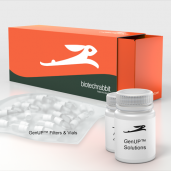
GenUP™ PCR/Gel Cleanup Kit
Package Sizes |
2X ApStarTaq™ Hot-Start PCR Master Mix
Package Sizes |
4X CAPITAL™ qPCR Probe Master Mix, lyophilized
Package Sizes |
Proteinase K
Package Sizes |
RTS 100 Insect Membrane Kit
Package Sizes |